The Seventy-ninth Session of the WHO Regional Committee for South-East Asia concluded in Dili on Thursday, with Member States adopting key decisions to advance health equity, strengthen health systems and accelerate progress towards Universal Health Coverage.The four-day meeting, which began on 7 September, saw high-level participation, with Ministers of Health from Bangladesh, Bhutan, India, Maldives, Sri Lanka and Timor-Leste; the Vice-Minister from DPR Korea, senior health officials from Nepal and Thailand and delegates from ministries, representatives from civil society, international agencies, the UN and development partners from across the WHO South-East Asia Region joining in person and virtually.
dr Élia A. A. dos Reis Amaral, Minister of Health of Timor-Leste, was elected as the Chair of the 79th Regional Committee and will serve until the next Regional Committee session in the Maldives in 2027.
/countries/timor-leste/closing-ceremony-of-rc79.jpeg?sfvrsn=90da73ed_2 "Closing ceremony of RC79") Prime Minister of Timor-Leste Kay Rala Xanana Gusmão delivers opening remarks on the fourth day of the Regional Committee meeting. © WHO Timor-Leste, 2026
Prime Minister of Timor-Leste Kay Rala Xanana Gusmão delivers opening remarks on the fourth day of the Regional Committee meeting. © WHO Timor-Leste, 2026The meeting was marked by several significant moments. WHO Director-General Dr Tedros Adhanom Ghebreyesus became the first WHO Director-General to visit the country. President José Ramos-Horta also conferred the Collar of the Order of Timor-Leste on Dr Tedros and WHO Regional Director Emeritus Dr Poonam Khetrapal Singh, recognizing their contributions to global health. The Walk, Talk, Act Together for Health event drew scores of participants to promote physical activity and healthier lifestyles. On the final day, Prime Minister Mr Kay Rala Xanana Gusmão joined the opening of the plenary session, greeting Ministers and the Heads of delegation from Member States, delegates and WHO leadership.
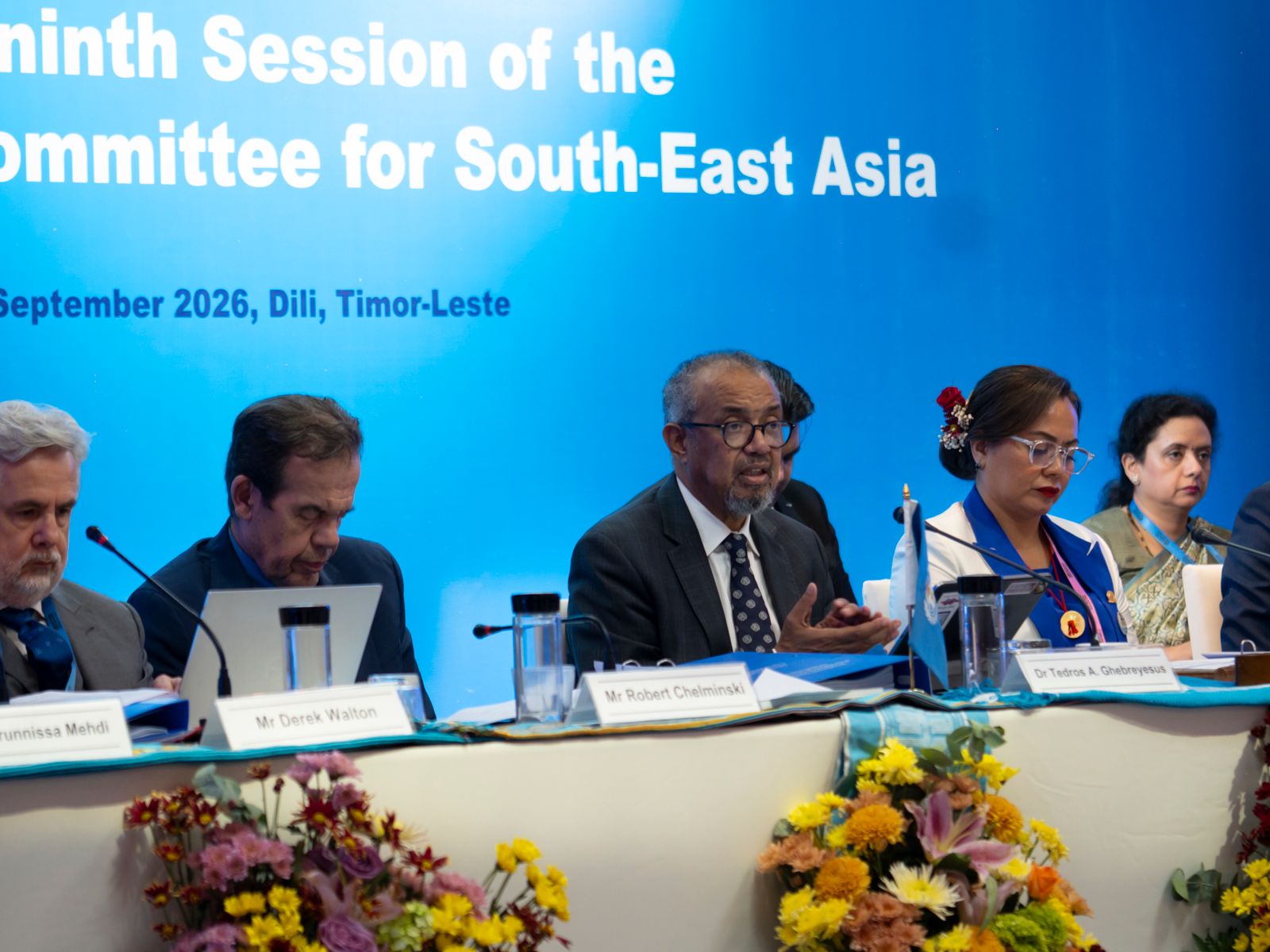
Dr Tedros Adhanom Ghebreyesus, WHO Director-General, addressing the plenary session. © WHO Timor-Leste, 2026
A major outcome was the adoption of the Dili Declaration on Human Resources for Health: Equity in Specialized Care, placing equitable access to specialist services at the centre of regional health workforce planning.
“The Declaration recognizes that access depends not only on having trained health professionals, but also on where they are located, whether they are available where needed, and whether they have the right competencies,” said Dr Nilesh Buddha, Officer-in-Charge, WHO South-East Asia Region. The Declaration provides a regional framework to address these disparities through stronger workforce planning and health-system capacity.
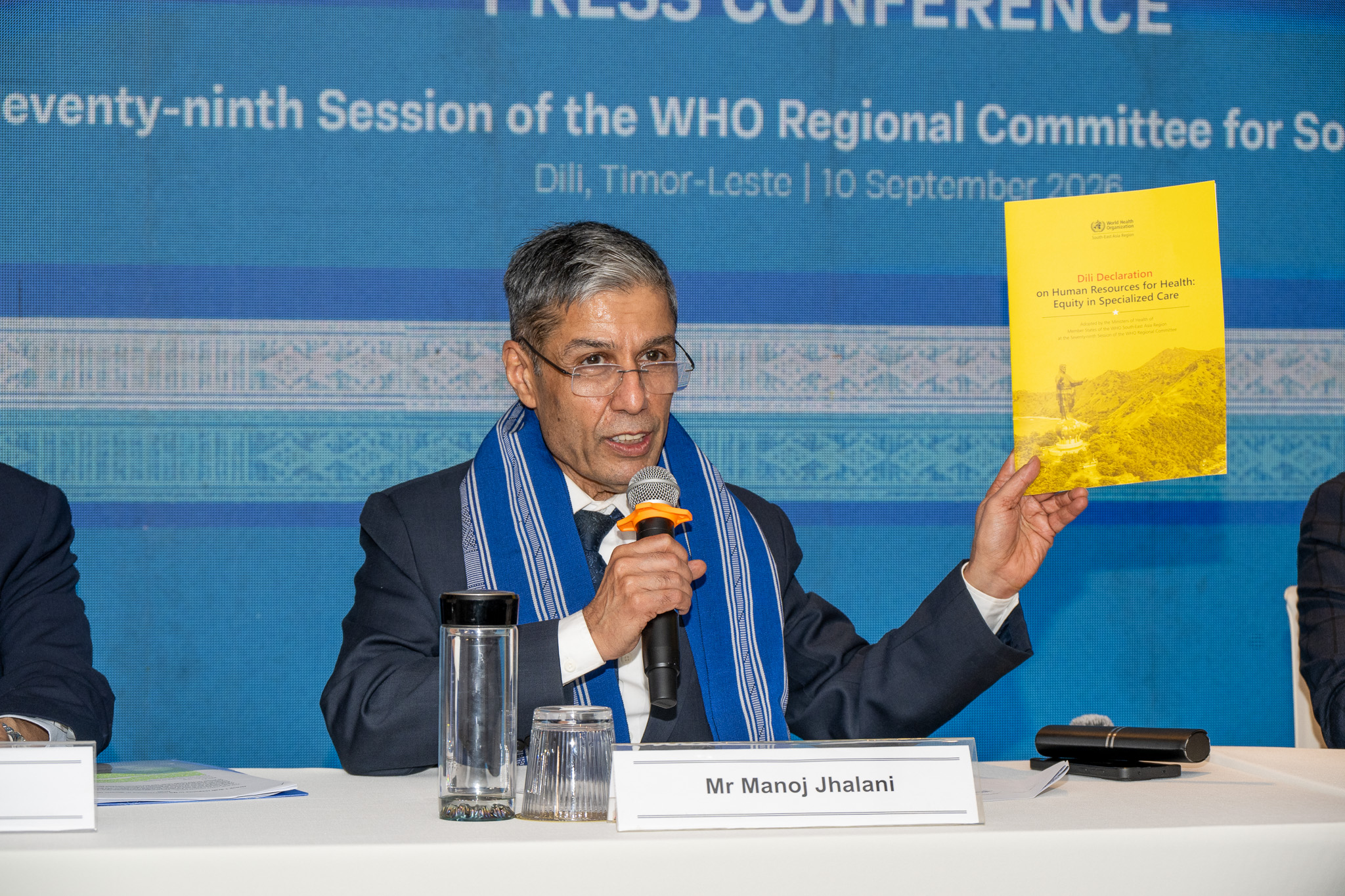
Mr Manoj Jhalani, Director, Department of Health Systems, WHO Regional Office for South-East Asia, showing a copy of Dili Declaration. © WHO Timor-Leste, 2026
The meeting also celebrated Timor-Leste’s elimination of trachoma as a public health problem, officially validated by WHO on 3 September 2026. With Timor-Leste’s validation, trachoma has now been eliminated as a public health problem across the entire WHO South-East Asia Region.
“This achievement is a source of immense national pride. Our responsibility now is to protect this progress and ensure that trachoma does not return,” said Mr Narciso Fernandes, Director-General of Cooperative Services, Ministry of Health.
The Regional Committee also featured five side events covering a range of priorities, including sexual and reproductive health and rights; the Universal Health and Preparedness Review (UHPR); climate change and health; ten years of SEARN; and protecting hard-won immunization gains in the WHO South-East Asia Region.
/countries/timor-leste/participants-during-from-evidence-to-action-side-event.jpeg?sfvrsn=a70ca086_2 "Participants during From Evidence to Action Side Event")
Key insights shared during the side-event, From evidence to action: Preventing VPD outbreaks and protecting hard-won immunization gains in WHO South-East Asia. © WHO Timor-Leste, 2026
Member States also adopted six resolutions covering medical devices, diagnostics and assistive technology; health facility resilience; patient and blood safety; sustainable health financing; ending tuberculosis; and strengthening vaccine confidence and uptake to advance measles and rubella elimination. Among them, the TB resolution renews the Region’s commitment to ending TB by 2030, with an estimated 3.68 million cases and 433 000 deaths in 2024 underscoring the scale of the challenge.
Digital health and artificial intelligence received a further boost with the establishment of the South-East Asia Digital Health and Artificial Intelligence Collaborative Network (SEA-DAC), enabling countries to share expertise and experience, strengthen digital health systems and advance the responsible use of AI.
Dr Arvind Mathur, WHO Representative to Timor-Leste, said RC79 underscored the value of regional cooperation in tackling shared health challenges and building more equitable health systems across the Region.